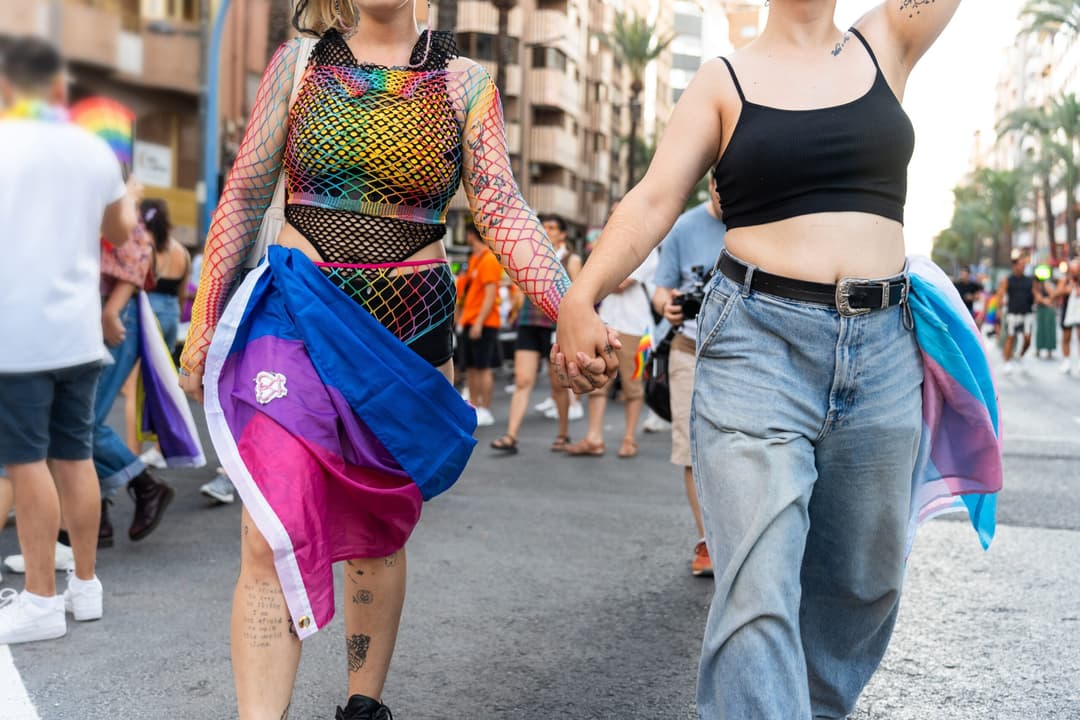
Radical Interdependence: What it Means to Rely on Each Other as Queer Disabled People

Radha is a queer disabled person of colour in their 30s. They care deeply about showing up with integrity, kindness, and humor in their relationships and community.
They are a writer, creative, facilitator, curator – hoping to create passionate and powerful spaces where other queer disabled people of colour can thrive.
In this piece, they offer their thoughts on mutual aid and the care that we give and receive.
Disabled people care too.
Care has historically been framed as something that has been done to disabled people, which is associated with paternalism, dependency, and abuses of power.
But I would ask that we challenge the binary care giver/care receiver categorisations that position disabled people as passive care receivers, often in the imagery of state welfare systems (Edwards & Loughnane, 2024).
Being a disabled LGBTIQA+ person of colour, means I sit at the intersection of multiple marginalisation, a minority within a minority, often feeling out of place in both disabled and queer spaces.
Living with disability is only one aspect of my life, I am also shaped by a variety of other identities, characteristics, life experiences like gender, sexual orientation, cultural background, faith, migration history, or my unrelenting desire for spicy food.
I could list off issues relating to intersectionality, identity, acceptance, belonging, and even my internal narrative defaults to recounting experiences of stigma, discrimination, and societal attitudes. But the truth is – this is how I have been made to feel about myself, that I need to be able to articulate my oppression and need for support perfectly at all times to get help, funding, to simply be believed.
Society will always look to reduce LGBTIQA+ disabled people to their perceived needs, not as a part of the human experience, but as a deviation from it. Every system is set up to place me back into the passive deficit formal (paid) care relationship. But once I started to build support around me, I learned that all of us have a shared relationality and sociality that is informal, dynamic, and forever shifting.
Mutual Aid
Mutual aid is the practice of collective coordination to directly support each other’s survival needs, rooted in solidarity not charity.
It is how we care for each other while working to change the world. It is not restricted by eligibility criteria like government aid, which often faces threats of being taken away at every election and often delivered in racist or ableist ways. We understand that the crises we are facing are caused by the systems we are living under, and are worsened by these systems (Spade, 2020)
Terms like collective care and mutual aid were invented by radical disabled women and nonbinary people of color who were, and are, part of the disability justice movement (Piepzna-Samarasinha, 2021). Leah recalls what their friend San Alland wrote in remembrance of their friend Callie Gardner who passed away, of how they wrote about living through the pandemic as multiply-marginalised trans and non-binary people and how the two of them checked in on and supported each other, “We were maybe not going to save the world, but we were going to save each other.”
As a queer disabled person, my mutual aid practices are often small, creative, and private. But it’s not always fun. Sometimes we’re all in bad moods because none of us are well because our needs are not being met, sometimes it’s about helping the people who piss you off. It’s not always showing up with a fridge full of food and being ready to pick up the phone at any point, that’s never going to be sustainable and I had to learn that too.
Sometimes it’s about making a flyer for a community fundraising event. Or organising a medical folder and setting up an appointments calendar for someone else. Other times, it’s about making a playlist to get people into a different mood or sending media recommendations to help people with distraction, sharing stories and bad jokes together over voice memos. Or the quieter work of remembering to check in with someone
There are still so many ways I practice mutual aid, especially when I can’t leave the house.
On Visibility
To be queer and disabled is a practice in both hypervisibility, and invisibility.
But truly embracing interdependence requires you to not only be visible, but to be seen. And that requires us to show up as our true selves and be transparent about our needs and capacity (brown, 2015).
The defensiveness I feel about interdependence is embedded within narratives of being a burden or that my ‘ask for help’ tokens have run out. It’s a myth and it has to be unwound.
But the result of offering up the smaller parts of myself over and over again, means I feel more woven into the world (brown, 2015).
It is only through other queer disabled people that I found real love and care. People who challenged me, wiped my tears, screamed and laughed with me. Not just when I asked for help or could immediately equalize the offer, but when I couldn’t offer much in return and had no idea when that would change (brown, 2015).
I had to trust that these networks were built on the belief that we all offer support in dynamic ways, at different points in each other’s lives and rejecting the idea that this exchange always had to be immediate.
The mutuality that underpins my disability care practices extends beyond personal relationships, to the local community, wider social and political networks, and our environment. These relationships intermingle in diverse and complex ways, within formal and informal systems.
Queer disabled people actively create politicised spaces of care because we recognise that we make visible and significant care offerings within our relationships, communities, environments and political systems. One thing I know for sure is that whether we like it or not, we need each other now more than ever.
Where to
find support
Looking for someone to talk to?
Find peer groups, community organisations and referral pathways for LGBTIQ+ women and gender diverse people.